 RF cat corner
Backoff calculations.
Dec 22, 2025Many thanks to my management at Eutelsat who kindly allowed me to republish this document I wrote for internal use here. Many thanks to my fellow colleagues for their help in this document.
Introduction
Power amplifiers have a limit on the maximum power they can amplity while staying linear, that is, keeping distorsion low enough.
For sinusoidal signals, it is straightforward to keep the power of the signal below the maximum linear power. However, for multi-carrier signals, the signal has peaks much higher than its average power, and keeping these paks below the maximum linear power requires to have a maximum power much higher than the average power, which is costly and inefficient in power.
Since these peaks are rare, it is possible to accept that some peaks go beyond the maximum linear power, provided that the resulting distorsion is acceptable. This allow to reduce the difference between the average power and the maximum power of the amplifier.
The needed difference between the average power and the maximum power, called backoff, is not straightforward to calculate for multi-carrier signals. This article proposes an investigation of this topic and guidelines to estimate the needed backoff.
The multi-carrier signal occurs either due to multi-carrier modulation schemes or when an amplifier serves multiple users.
Existing rules of thumb do not provide a precise method to make a compromise between an high backoff, which wastes power, and a low backoff, which may not provide enough linearity. The peak to average power ratio (PAPR) is insufficient since it does not indicate how often peak levels are reached.
Modelling
An ideal amplifier has a linear transfer function in an infinite range.
Real amplifiers have a limited linear range and their transfer function is closer to the saturated cubic
model of following curve.
This saturated cubic function is hard to model so the cubic model, valid for signals lower than saturation of the amplifier, is used instead. This is the domain of most often used in telecommunications.
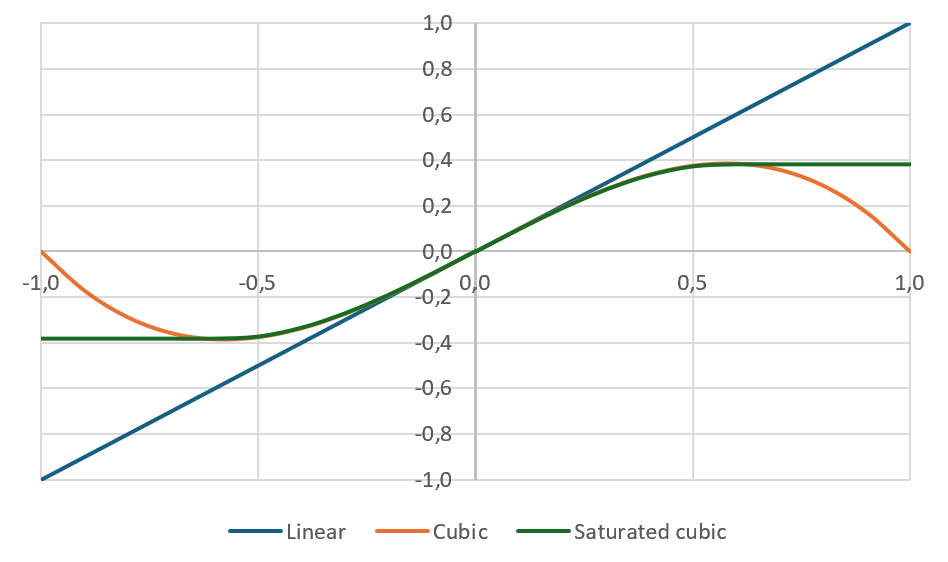
This cubic transfer function can be expressed by the following equation:
Signals are modelled as a complex amplitude at amplifiers centre frequency.
This approach is based on the works of Roblin and Versprecht.
The following assumptions are made:
- Nonlinear effects are modelled as an amplitude transfer function (without phase effects, without memory effects).
- Even-order terms are ignored since they produce out-of-band distortion.
- Higher-order odd terms are considered negligible compared to third-order terms.
- Conjugate terms correspond to reverse spectrum output signals, which are eliminated through filtering.
- Gain is normalized to unity because all variables of interest are normalized to output (OIP3, Psat, …).
- Units and impedances are ignored:
\text{power}=\left|x\right|^2 . No\sqrt{2} is present in the power formula because complex sinusoids are considered instead of real sinusoids.
Parameters in function of OIP3
An input signal x consisting of two equal-amplitude complex sinusoids at angular frequencies
where A is the amplitude of each sinusoid.
To compute the tones produced by the transfer function:
The first step is to compute
The second step is to expand the non-linear term
The total output can be split into fundamental and intermodulation components.
The total fundamental part is:
Its amplitude is changed by the non-linear effects. However, from the OIP3 definition, only the linear part should be taken.
The total linear part is:
and its RMS amplitude is:
The total intermodulation part is:
and its RMS amplitude is:
The
thus:
Non-linear power for a gaussian input
A multi-carrier signal, at both input and output, which may or may not be at the same frequency, is modelled by its complex amplitude centred on the device’s centre frequency:The complex amplitudes

To simplify calculations, the input/output power is normalized to 1, so:

Power of linear component
The linear part of the output is:
which has a power of:
which is consistent with our normalization hypothesis.
Power of non-linear component
The non-linear part of the output (including change in fundamental) is given by:
whose power is:
It can be calculated as follows:
The total power of
Power of the non-linear component in function of the OIP3 and the backoff
The ratio
This can be calculated as follows by combining the previous results:
which can be expressed in dBc since the output power is normalized to unity:
and expressing the OIP3 in dBm:
From this, the maximum ouput power for a given
with the absolute value to get rid of the sign issues in
In telecommunications, the maximum power is more often used than the
The quantity linearity factor
because it it higher when the amplifier is more linear. Estimations of this quantity will be given in the following sections.
The quantity output backoff
and can be expressed as:
Values of the linearity factor LF for different technologies
The previous equations for the calculation need
TWTA
LF between 4 and 6.
| Mfg. | Name | Description | Psat [W] | Psat [dBm] | IM [dBc] | IM value at [dBm] | OIP3 [dBm] | OIP3 - Psat [dB] |
|---|---|---|---|---|---|---|---|---|
| CPI | T04UO-A1 | 400 W CW TWTA | 400 | 56,0 | -24,0 | 49,0 | 61,0 | 5,00 |
| CPI | TL07UO | 750 W SuperLinear® TWTA5 | 750 | 58,8 | -24,0 | 51,2 | 63,2 | 4,45 |
| CPI | T07UO | 750 W CW TWTA6 | 750 | 58,8 | -24,0 | 51,1 | 63,1 | 4,35 |
| CPI | TL12UO-A1 | 1.25 kW SuperLinear® TWTA (Air Cooled)7 | 1250 | 61,0 | -25,0 | 54,3 | 66,8 | 5,84 |
| CPI | TL12UO-L1 | 1.25 kW SuperLinear® TWTA (Liquid Cooled) | 1250 | 61,0 | -25,0 | 54,3 | 66,8 | 5,84 |
TWTA with linearizer
Same products as before but with linearizer option. LF between 8 and 9.
| Mfg. | Name | Description | Psat [W] | Psat [dBm] | IM [dBc] | IM value at [dBm] | OIP3 [dBm] | OIP3 - Psat [dB] |
|---|---|---|---|---|---|---|---|---|
| CPI | T04UO-A1 | 400 W CW TWTA | 400 | 56,0 | -24,0 | 52,0 | 64,0 | 8,00 |
| CPI | TL07UO | 750 W SuperLinear® TWTA | 750 | 58,8 | -25,0 | 55,2 | 67,7 | 8,95 |
| CPI | T07UO | 750 W CW TWTA | 750 | 58,8 | -26,0 | 54,1 | 67,1 | 8,35 |
| CPI | TL12UO-A1 | 1.25 kW SuperLinear® TWTA (Air Cooled) | 1250 | 61,0 | -25,0 | 57,3 | 69,8 | 8,85 |
| CPI | TL12UO-L1 | 1.25 kW SuperLinear® TWTA (Liquid Cooled) | 1250 | 61,0 | -25,0 | 57,3 | 69,8 | 8,85 |
SSPA
LF between 8 and 10.
| Mfg. | Name | Psat [W] | Psat [dBm] | IM [dBc] | IM value at [dBm] | OIP3 [dBm] | OIP3 - Psat [dB] |
|---|---|---|---|---|---|---|---|
| SpacePath | STS168 | 20 | 43,0 | -25,0 | 39,0 | 51,5 | 8,5 |
| SpacePath | ST209 | 25 | 44,0 | -25,0 | 40,0 | 52,5 | 8,5 |
| SpacePath | ST25K10 | 32 | 45,0 | -25,0 | 41,0 | 53,5 | 8,5 |
| SpacePath | STS25011 | 251 | 54,0 | -25,0 | 51,0 | 63,5 | 9,5 |
| SpacePath | STS30012 | 316 | 55,0 | -25,0 | 52,0 | 64,5 | 9,5 |
| SpacePath | STS40013 | 398 | 56,0 | -25,0 | 53,0 | 65,5 | 9,5 |
| SpacePath | STS50014 | 501 | 57,0 | -25,0 | 54,0 | 66,5 | 9,5 |
| Advantech | SapphireBlu15 | 1000 | 60,0 | -25,0 | 56,5 | 69,0 | 9,0 |
https://web.archive.org/web/20251012085656/https://www.space-path.com/sites/default/files/document-downloads/Datasheet%2016%2020%2025W%20Ku%20Band.pdf ↩
https://web.archive.org/web/20251012085656/https://www.space-path.com/sites/default/files/document-downloads/Datasheet%2016%2020%2025W%20Ku%20Band.pdf ↩
https://web.archive.org/web/20251012085656/https://www.space-path.com/sites/default/files/document-downloads/Datasheet%2016%2020%2025W%20Ku%20Band.pdf ↩
https://web.archive.org/web/20251012074035/https://www.space-path.com/sites/default/files/document-downloads/STS250%20300%20400%20500%20K.pdf ↩
https://web.archive.org/web/20251012074035/https://www.space-path.com/sites/default/files/document-downloads/STS250%20300%20400%20500%20K.pdf ↩
https://web.archive.org/web/20251012074035/https://www.space-path.com/sites/default/files/document-downloads/STS250%20300%20400%20500%20K.pdf ↩
https://web.archive.org/web/20251012074035/https://www.space-path.com/sites/default/files/document-downloads/STS250%20300%20400%20500%20K.pdf ↩
https://advantechwireless.com/wp-content/uploads/2022/11/PB-SAPPH-2G-Ku-1000W-22245-LM.pdf ↩
SSPA with dubious linearization
To be continued. The example found has a surprisingly low LF.
| Mfg. | Name | Psat [W] | Psat [dBm] | IM [dBc] | IM value at [dBm] | OIP3 [dBm] | OIP3 - Psat [dB] |
|---|---|---|---|---|---|---|---|
| Teledyne | HPAK2600AHXXXXXG16 | 600 | 57,8 | -25 | 54,8 | 67,3 | 9,5 |
Calculated values of backoff for - 20 dBc
The value of LF depends on the technology but is surprisingly constant inside a given technology. It is this possible to calculate recommended backoff values for each technology.
| Technology | LF min | Back-off |
|---|---|---|
| TWTA | 4 | 9,9 |
| TWTA with linearizer | 8 | 5,9 |
| SSPA | 8 | 5,9 |