This page is a quick and dirty translation of a previous French document. Various editing issues are susceptible to be present.
A few words on the notion of transistor output impedance
In [PhD thesis section 16.1], we set aside the real behavior of power amplifiers to focus on the behavior of their loads, i.e., the inputs of the power combiner. Power amplifiers operating at high power are nonlinear, which causes particular effects on the behavior of their outputs. We will detail these effects in the following section.
Behavior of a simplified nonlinear power amplifier
Let us consider a simplified nonlinear amplifier. We will initially assume that it reacts instantaneously to its inputs, i.e., its response is frequency-independent. The model will be extended to incorporate frequency variations in the following section. Suppose its response can be described in the time domain by the equation below:
b_2(t) = \underbrace{G \cdot a_1(t)}_{\text{Gain in small signals}} - \underbrace{\gamma \cdot a_{1}^{3}(t)}_{\text{Gain compression}} + \underbrace{\Gamma \cdot a_2(t)}_{\text{Output reflection in small signals}} - \underbrace{\lambda \cdot a_{1}^{2}(t) \cdot a_2(t)}_{\text{Variation of reflection with input, self-biasing}}
This model is highly simplified but already contains the effects found in real amplifiers: small-signal gain, gain compression for large signals, output reflection, self-biasing, and variation of the output reflection coefficient as a function of input power.
For numerical examples, let us take the following values:
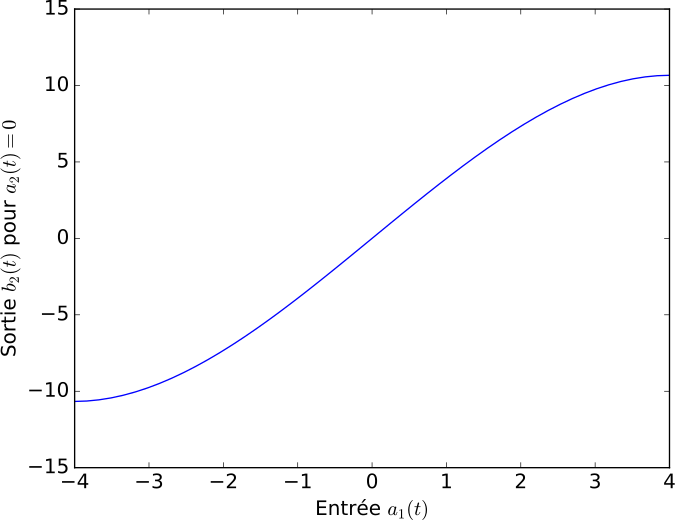
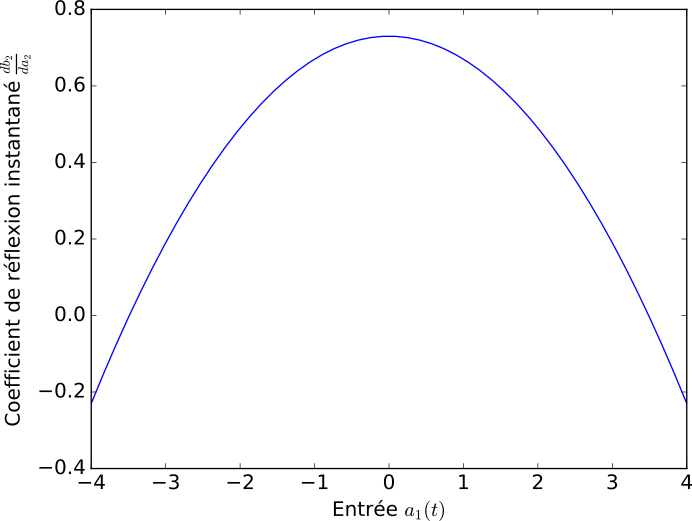
Figures \ref{fig-plt-non-lineaire-b2-a1} and \ref{fig-plt-non-lineaire-r2-a1} show respectively the instantaneous value of the output b_2(t) and the instantaneous reflection coefficient \frac{db_{2}(t)}{da_{2}(t)}, both as a function of the input a_1(t).
Output b_2(t) as a function of input a_1(t).Instantaneous reflection coefficient \frac{db_{2}(t)}{da_{2}(t)} of the output as a function of input a_1(t).
This nonlinear equation can be linearized [1,2] around an operating point, which we will call “LSOP” for “large signal operating point”. This operating point is:
We ignore the terms in e^{3 i \omega t} and e^{-3 i \omega t} which correspond to the third harmonic of the signal, and we are interested in the amplitude of the terms in e^{i \omega t} and e^{i \omega t}:
b_{2}(t) = \frac{ B_2 \cdot e^{i \omega t} + B_{2}^* \cdot e^{- i \omega t} }{2} + \text{terms in } e^{3 i \omega t} \text{ and } e^{-3 i \omega t}
This linearization is a simplified version of the X parameters [1,2].
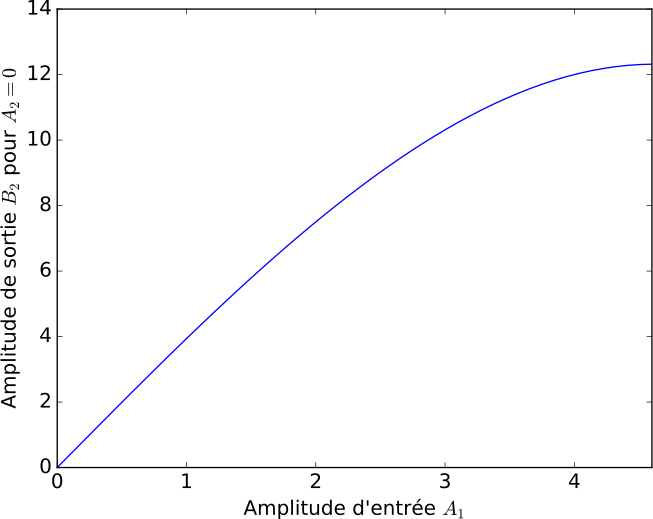
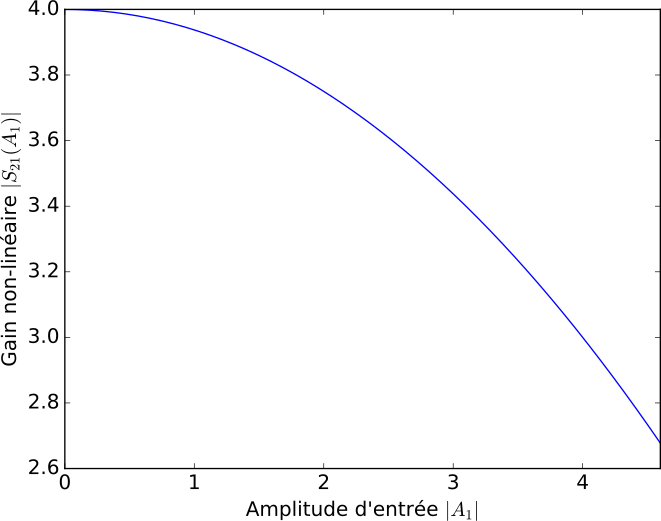
The amplitude of B_2 in large signal regime for A_2=0 as a function of A_1 is shown in \cref{fig-plt-non-lineaire-complexe-B2-A1}. This figure is different from \cref{fig-plt-non-lineaire-b2-a1} because the latter is an instantaneous transfer function while the former is a sinusoidal regime transfer function. The nonlinear gain S_{21}(|A_1|) is shown as a function of |A_1| in \cref{fig-plt-non-lineaire-S21}. We recognize the classic gain compression of nonlinear amplifiers.
Output amplitude B_2 as a function of |A_1| in large signal regime.Nonlinear gain S_{21}(|A_1|) as a function of |A_1|.
The contribution of \delta A_2 to B_2 is denoted \delta_2 B_2 and is given by
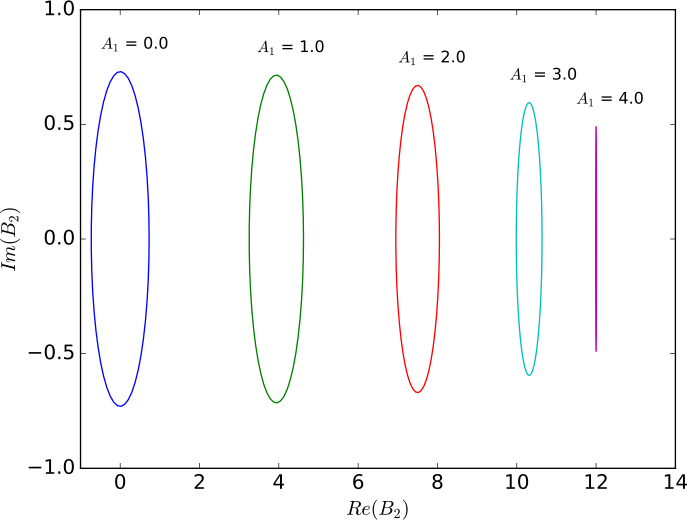
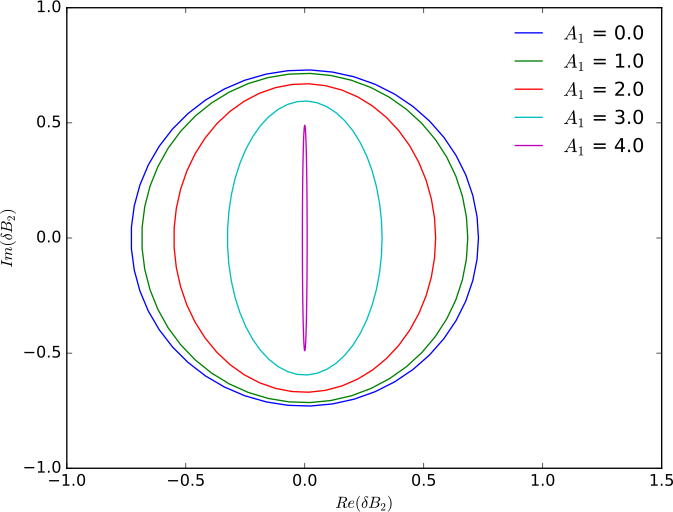
and \delta B_2 are shown respectively in \cref{fig-plt-non-lineaire-complexe-b2-b2-a1} and \cref{fig-plt-non-lineaire-complexe-deltab2-b2-a1} when \delta A_2 describes a circle.
\delta B_2 when \delta A_2 describes a unit circle for different values of A_1.\delta B_2 when \delta A_2 describes a unit circle for different values of A_1.
The first term depends only on the amplitude of A_1 and behaves exactly like a classic S_{22} (except, of course, for the amplitude dependence) [1,2]. On the other hand, the second term is more particular. It depends not only on the amplitude of A_1 but also on the phase difference between A_2 and A_1[1,2].
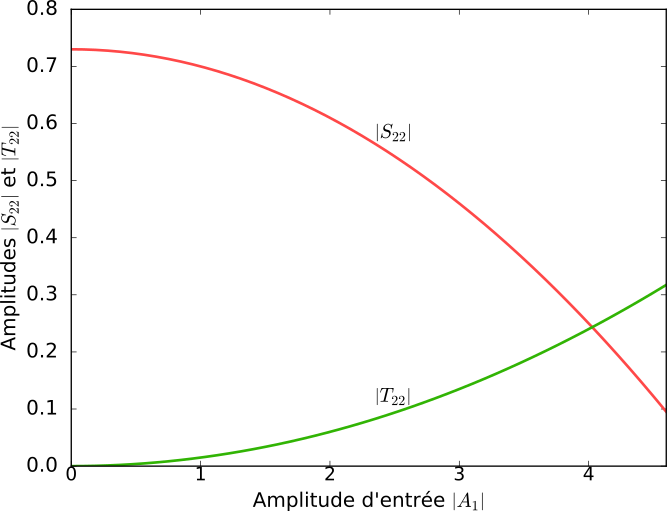
The coefficient T_{22} is simply neglected in classical large-signal S-parameter approaches [1,2]. This term is zero at low power but can exceed S_{22} when approaching saturation [1,2], as shown in \cref{fig-plt-non-lineaire-s22-t22}. Therefore, two terms are needed to completely describe the output reflection of the amplifier. Note that it is clearly seen in \cref{fig-plt-non-lineaire-s22-t22} that the output matching of this amplifier is very poor at low power but excellent at full power. This is also a classic effect of real power amplifiers.
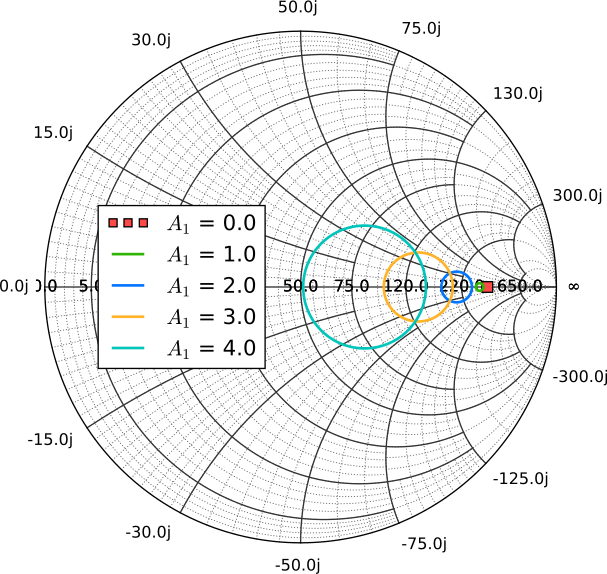
Coefficients S_{22} and T_{22}. The coefficient T_{22} is zero at low power but exceeds S_{22} in saturation.Apparent reflection coefficient of the output \Gamma_2 for different input amplitudes |A_1|.
The strange behavior of the T_{22} term deserves further discussion. Surprisingly, and although it arises from nonlinear phenomena, this term translates a linear behavior. Indeed, if the perturbation \delta A_{2,\text{total}} is the superposition of two perturbations:
This linearity, surprisingly again, is perfectly normal. Indeed, we spent an entire section linearizing the power amplifier around an operating point. A linearization that would not result in a linear model would be an absurdity.
However, this is not ordinary linear behavior, and ordinary linear systems, which can be described by classical S parameters, do not exhibit it. Why this paradox?
Because the T_{22} term translates a time-varying linear behavior. However, classical linear systems are time-invariant.
In summary, the linearization of a time-invariant nonlinear system around a time-varying operating point (it’s a cosine!) results in a time-varying linear model. This linear model cannot be described by S parameters because these S parameters are reserved for time-invariant linear systems.
The correct way to describe this linearization is the use of X parameters [1,2]. The coefficients of the previous section are almost X parameters.
It is always possible to calculate an apparent output impedance from the apparent reflection coefficient of the previous section, but is it correct to speak of the output impedance of a nonlinear amplifier? \cref{fig-plt-non-lineaire-Gamma2} clearly shows that a power amplifier in saturation has multiple impedances depending on the output perturbation. Which one is correct? Moreover, is the term “impedance” still appropriate, given that this impedance does not have the usual properties of an impedance?
One way to see things is to say that a power amplifier does not have a well-defined impedance. Another is to say that a power amplifier has two output impedances: one for signals in phase with the input signal and another for quadrature signals. But it is wrong to say that a power amplifier has a single output impedance independent of the phase of B_2.
This poses a problem because we need an output impedance, or something close to it, to perform our matching calculations. We will therefore reverse the problem. Instead of asking what the output impedance of the power amplifier is, we will ask what its optimal load impedance is. In our applications, the load is the input of a power combiner followed by an antenna. This load is linear and time-invariant. The load impedance is therefore well defined.
To simplify the reasoning, and by abuse of language, we will call “output impedance” the conjugate of the optimal load impedance. But it is indeed a fiction, given the previous reservations about the notion of output impedance applied to nonlinear systems.
We have talked about amplifiers but not yet about transistors. The same remarks apply to a transistor, but with an additional reservation: since transistors are not matched, the operating point is more complex to define [1]. The conclusions are however globally similar [1].
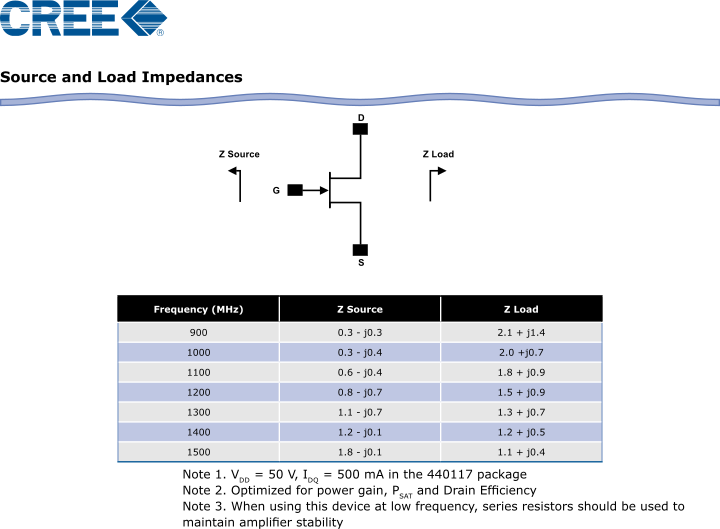
Reasoning with load impedances is a common practice in the field of transistor amplifiers. This is the principle of load-pull, whether performed in reality or on a simulator. Similarly, in its datasheets, an example of which is shown in \cref{fig-CGHV14500-datasheet-impedances}, Wolfspeed (formerly CREE) does not provide the output impedances of its transistors but rather the optimal load impedances. QED.
Extract from the CGHV14500 datasheet showing optimal source and load impedances. Not those of the transistor.
References
[1] David E. ROOT, Jan VERSPECHT, Jason HORN, Mihai MARCU. “X-Parameters: Characterization, Modeling, and Design of Nonlinear RF and Microwave Components.” Cambridge University Press, 2013.
[2] Jan VERSPECHT et David E. ROOT. “Polyharmonic distortion modeling.” In: IEEE Microwave Magazine 7.3, IEEE (juin 2006), p. 44-57. URL: http://www.janverspecht.com/pdf/phd_ieeemicrowavemagazine.pdf
 RF cat corner